
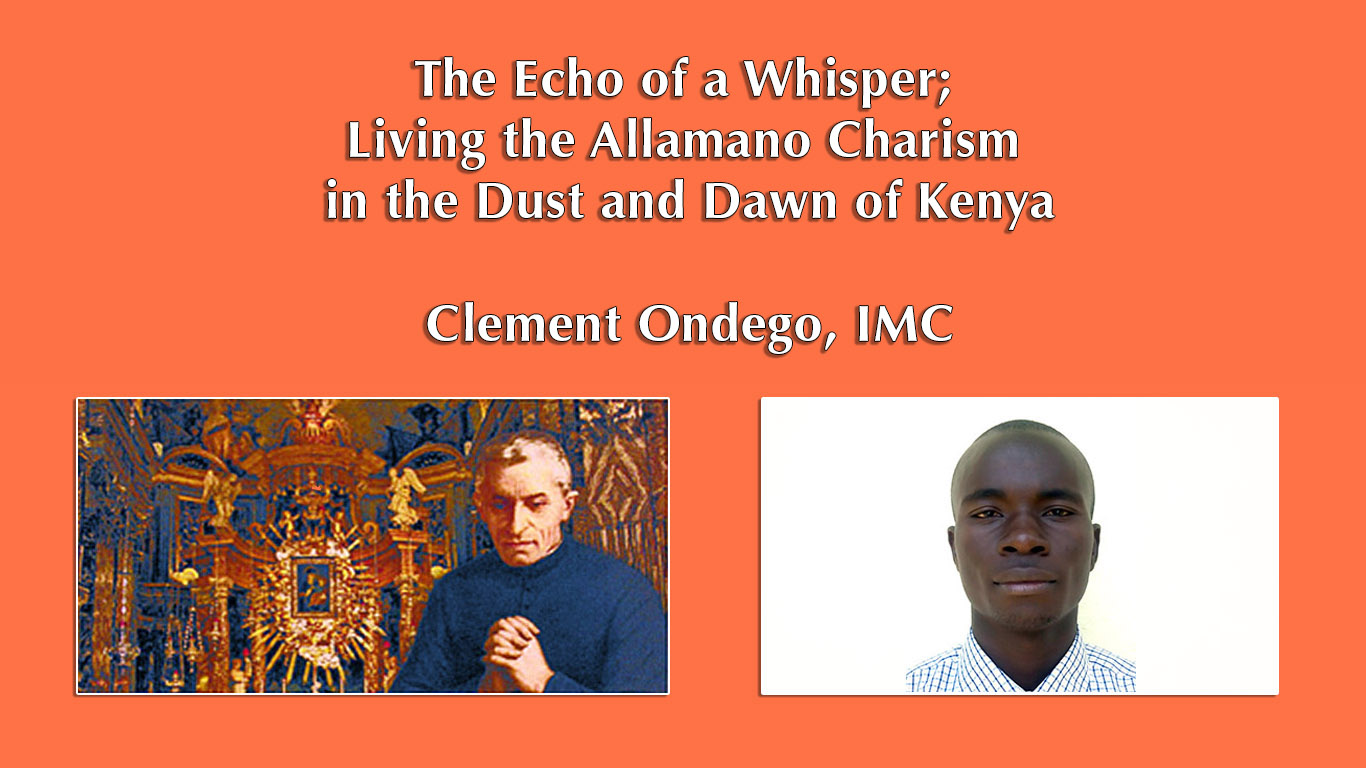
The Kenyan sun holds nothing back; it paints the red earth in bold strokes and presses the scent of acacia blossoms into the air. Here, in this vibrant, demanding land, my nearly 13-year journey as a Consolata Missionary in formation has unfolded. It is a path walked not alone, but in the steady, unseen company of a man who died a century ago; Saint Joseph Allamano. As our Institute celebrates the centenary of his passing, I do not merely recall a historical figure. I bear witness to a living charism, a spirit that breathes through our community, our prayers, and the very dust of our mission stations. This reflection is my personal testament, a story of how the whisper of a Founder, heard in the quiet of my heart, finds its thunderous echo in the lives of the people of Kenya.
My first encounter with St. Joseph Allamano was through words on a page. “First of all, be holy.” I read it in the magazines I received from the vocations, director Fr. Kizito Mukalazi back in my days in High school and later in the Constitutions and other several documents of the institute. At first, it felt like a lofty ideal, a distant mountain peak. Holiness belonged to saints in stained glass. But Kenya mission activity and experience taught me to read that quote with new eyes. I saw it in the hands of an elderly missionary, worn out from work, gently receiving and assisting a sick parishioner. Holiness was not a state of perfection. It was a direction. A daily choice to serve, to listen, to be present in the exhausting, beautiful mess of humanity. St. Joseph Allamano’s call to holiness became tangible. It was in the patience needed to learn Kikuyu, Samburu, Turkana, Meru... and in the humility to be taught by the people I came to serve. In the silent prayer before a long journey on rough roads. Holiness was the foundation, the “first of all,” without which everything else would crumble.
Then came our missionary identity: “Missionaries, not by chance, but by choice. Not for a short time, but for life.” This conviction, woven into our documents, ceased to be a simple vow. It became my story. I remember a moment in a remote village in the arid North. We had worked for days with a community on a water project. The joy when the first clean water gushed forth was indescribable. In that shared celebration the laughter, the tears, the songs of gratitude, I understood “choice” and “for life.” It was the choice to stand in solidarity, not as a benefactor, but as a brother. It was the commitment to share not just water, but hope. St. Joseph Allamano’s vision was no longer abstract. It was in the trusting gaze of a child, in the shared meal with a family, in the slow, steady work of building the Kingdom of God, brick by brick, relationship by relationship.
The charism, Consolata “Consoler.” St. Joseph Allamano urged us to “bring consolation to the heart of God by saving souls.” In the bustling streets of Nairobi’s informal settlements, I saw what this meant. It was not about offering cheap comfort. It was about being a presence that illuminates darkness. I sat with a mother grieving her son lost to tribal-post election violence. Words failed. But the ministry of presence, the silent sharing of her sorrow, was consolation. It was witnessing to a love greater than hatred. We console God’s heart by mending the broken hearts of His children. We do it through education, healthcare, and advocacy for justice. But most profoundly, we do it by simply being there, as Allamano was there for the poor and forgotten of Turin. His spirit compels us to see Christ in every face, especially the most wounded.
Perhaps the most personal whisper from St. Joseph Allamano is found in his profound document, “This I Want You To Be.” He writes with a father’s clarity. He asks for generosity, humility, and a spirit of sacrifice. He warns against mediocrity. In the long journey of formation, with its moments of doubt and fatigue, this text has been my mirror. There were times when the mission felt overwhelming. The cultural gaps seemed unbridgeable. I felt inadequate. In those moments, I returned to his fatherly advice. “Trust in God and go ahead,” he would say. He did not promise ease. He promised meaning. He shaped an Institute not of heroes, but of faithful, trusting servants. Living this charism means embracing the joy of service alongside the ache of distance from family. It means finding God not in dramatic signs, but in the faithful rhythm of daily prayer and work.
One hundred years after his death, Saint Joseph Allamano does not feel absent. He is a living voice in the Constitutions that guide us. He is a compassionate gaze in the clinics, children’s homes and schools we run. He is a steadfast faith in the hearts of missionaries serving across continents. My close to thirteen years in the institute has been a dialogue with father Founder. His quotes are not relics. They are living seeds that have taken root in the soil of my vocation and blossomed in the sunlight of Kenyan community.
As we celebrate this centenary, we do not look back with nostalgia. We look forward with recognition. The Institute St. Joseph Allamano founded is the ongoing embodiment of his “continuous and steadfast Yes” to God. We are his legacy, not in stone, but in spirit. In the laughter of a child at our children’s homes, the joy in the face of the abandoned old lady at our house of the aged, in the dignity of a farmer with a new skill, in the peace of a community reconciled, the whisper of St. Joseph Allamano finds its enduring echo. He taught us that mission is about love made visible. And so, we continue. With red dust on our shoes and his charism in our hearts, we walk forward. We strive, as he desired, to be holy and consolers. For in giving ourselves, we truly find him, and in him, we find the reason for our every joy and sacrifice. Ad Multos Annos, Father Allamano.