
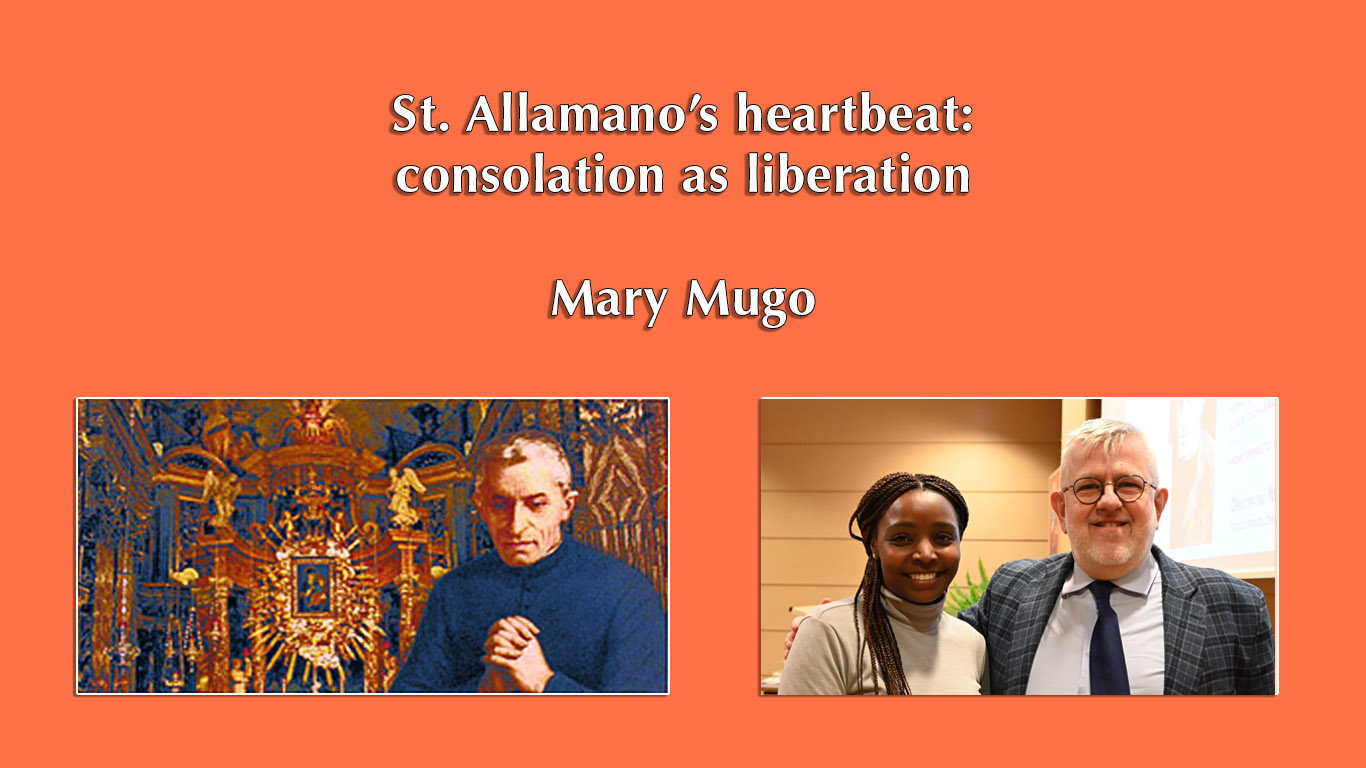
As a Consolata lay missionary, I work where advocacy meets rescue. My daily mission against human trafficking and gender- based violence is a direct expression of the Consolata charism. In the shadows of these tragedies, I find that Saint Joseph Allamano’s call to holiness is not just a theory, it is a lifeline.
When I think of Saint Joseph Allamano, I see a man whose heart was full of God’s Love that could not remain still. In 1901, moved by profound desire to bring both spiritual comfort and human advancement to those fare off, he founded the Consolata Missionaries in Turin. His life was a living testament to the presence of God in the world and his mission reminds me that love must always take form in action. His voice echoing across time, calls me to bring consolation where despair has taken roots, to rekindle light where darkness threatens to overwhelm and to plant hope where humanity has been trampled. He left us a blueprint for mission that I carry into every rescue; “This I want you to be: generous, strong and constant in your vocation.” (cf. This I want you to be).
In the context of anti-trafficking, these are not just virtues, they are necessities for survival and restoration. Generosity demands an expansive heart that offers unconditional presence and tireless empathy to a survivor whose trust has been shattered. To be strong is to have the courage to face the systems of exploitation and the physical dangers of rescue. To be constant is to stay the course through the long, grueling process of legal advocacy and emotional healing even when justice seems far away. St. Joseph Allamano insisted these qualities must be rooted in prayer and the Eucharist. Central to this spirituality is his deep devotion to Mary, Mother of Consolation; he taught that we must first allow ourselves to be consoled by her so that we may become true instruments of consolation for others. In this way, consolation becomes not an act performed occasionally but a life transformed by the presence of God, a continuous reaching towards the broken, the lonely and the rejected.
In my work, I meet women whose lives have been stolen and trafficked into sexual exploitation, forced labor and abuse. I see their eyes haunted by fear, their bodies marked by suffering, their voices silenced by shame and oppression. Yet in their silence, I hear a plea louder than any words; the call to be seen, to be heard and to be restored. I am reminded of St. Joseph Allamano’s insistence that we must do “good, and do it well,” combining professional excellence with a missionary heart. In their struggle, they reflect the very heartbeat of Saint Joseph Allamano’s mission that love must be practical, tangible and present even where it seems impossible to act.
The heart of Allamano’s mission could be observed in this year’s theme of the International Day of Prayer against human trafficking. As the church observes this day in honor of Saint Josephine Bakhita, we are reminded that peace begins with dignity. St. Joseph Allamano teaches that true consolation must rebuild the dignity of those whose lives have been broken by injustices. Peace is not only the absence of conflict. It is when women can walk without fear, when girls are protected from danger and when every person’s humanity is recognized and respected. Following Saint Joseph Allamano, I understand that advocacy and rescue are not just services, they are sacred steps towards this enduring peace.
St. Joseph Allamano teaches that consolation is not “comfort for the comfortable” rather, it is courage for those who suffer and presence for those abandoned by society. To console is not only to heal wounds but to stand in solidarity and speak for justice. This legacy of self-giving has defined the institute since the first missionaries were sent to Kenya in 1902, proving that true ministry requires total surrender even when the work feels overwhelming beyond human capacity.
Each time I accompany a victim of exploitation, I witness a holy transformation: fear replaced by trust and a silenced voice rediscovered. I have realized that consolation is a bridge between captivity and life. It requires a belief that God is working even when human eyes perceive only shadows. As our Founder reminds us, we must often “hope against Hope.” Consolation demands that we break the chains of injustice and refuse to settle for mere pity. Emotions must be transformed into persistent, tangible acts of accompaniment.
To the entire Consolata family, Saint Joseph Allamano speaks today; “Do not turn away from suffering. Do not hide from broken. Be the hands, the heart and the voice that brings God’s consolation to those who have been forsaken.” These words call us to be bold. They remind us that mercy is not passive, that charity is not an abstract idea and that holiness is measured in the courage to intervene, to defend and remain present where others flee. He challenges us to live a faith that is active, incarnate and unafraid of encountering suffering directly.
In the faces of women I rescue, I see God’s own presence. In their resilience, I see the echo of St. Joseph Allamano’s holiness, a sanctity that calls us beyond ourselves into the work of human liberation. He taught that we must bring others into the presence of Jesus in the Eucharist so that every act of love is grounded in Christ. “I want you to be Eucharistic...so united with him you will be able to do much good.” Through this union, even the darkest experiences can become a space for grace, healing and transformation.
In the face of suffering, the world often recoils. Yet St. Joseph Allamano teaches that the church’s witness must not waver. Consolation is radical. It refuses to remain at a distance from pain. It enters the shadows and brings light. It sits quietly with those whose stories are silenced and dares to affirm that their lives matter. It is a call to unwavering presence, to a love that does not calculate cost and to faith that trusts in God’s providence even when human reason sees only impossibility.
And so, I continue to walk beside the broken, to whisper hope into lives overshadowed by fear, and to fight for justice because I follow the path of a Founder whose sanctity calls me to stand where hope seems lost. Saint Joseph Allamano speaks to me now saying: “Go where hearts are broken. Speak where voices are silenced. Love where humanity is wounded. You are not alone.” In this mission, I find my purpose, my faith and my courage answering the call of a saint who proved that to console is to liberate and to love is to set the world free.